
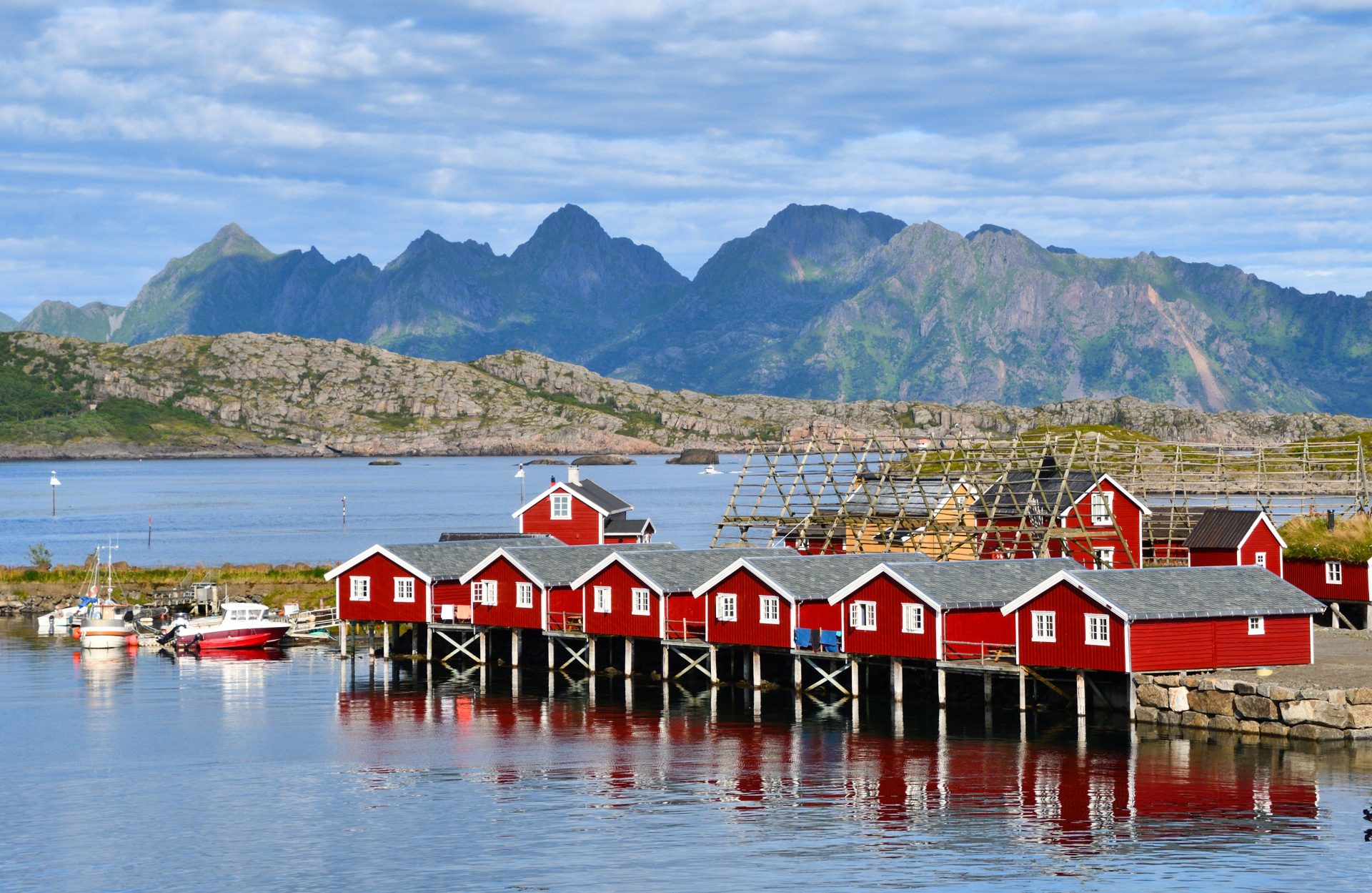
In the summer of 2024, we spent a week in the superb Lofoten. We drove the splendid Lofoten scenic route and vistited cosy sheltered fishing villages. We gazed at jagged mountain peaks in a pink sunset. And took an arctic swim in white beaches with crystal clear waters. My top 5 fantastic things to do in the Lofoten.
Drive the Scenic Lofoten Route
Definitely on your to-do list while visiting the Lofoten Islands: drive (part of) the Lofoten Scenic Route.
This is a drive with breathtaking scenery and a vibrant coastal culture. Along the drive, the ocean meets jagged mountain peaks, tiny sheltered fishing villages, and white beaches with crystal clear waters.

The ‘A 10’ runs between Raftsundet in the North all the way to Å in the south. Good for about 230 kilometers of splendid scenery.
Besides the ‘official’ rest stops, there are various detours to be made, such as Nusfjord, Utakleiv, Unstad and Henningsvær.
In short, this route is the ultimate way to explore the beautiful Lofoten.
We drove the route in 2 days.

When we arrived, we drove from the airport to Kabelvag. Kabelvag is located in the center of the Lofoten, at the south coast. We rented a house for 5 days. It’s an ideal place for further explanation.
From Kabelvag, we drove to Å in one long day, leaving very early in the morning and returning very late.
This gave us the time to visit the main highlights and combine history, beaches and nature


If you have more time to spend, I suggest making an additional stop. Stay the night, for example, in Å or Nusfjord.
The next day, you return and visit other things north or south, depending on your preference.
Visit Nusfjord, a typical fishing village

If there is one Lofoten village to visit, head to Nusfjord, listed as a UNESCO World Heritage Site.
This small village stands out for 2 reasons.
First, the village is beautifully located at the end of a secluded valley stretching toward the sea. Various rorbuer, the traditional fisherman cabins, in the typical bright red and yellow colors, stand out against a rough landscape.

Second, Nusjford is one of Norway’s oldest and best-preserved fishing villages.
The whole village feels like a museum. Walking around in Nusfjord feels diving into the history of Norwegian fishing.
We discovered an old-fashioned general store. We also found a cod liver oil factory, a sawmill, and a smithy. Traditional boats are there as well, all enriching you with stories of the past.


And then there is of course the excellent traditional bakery of Hansines Bakeri. It is a traditional stone oven bakery established in 1877. The cinnamon rolls are a local delicacy, maybe even the more because you can enjoy them outside in the beautiful surroundings.

Third, this village was not at all crowded, at least not when we visited. Maybe that’s because access is not free.
Indeed, you pay around NOK 100 per person, or around 10 euros. This entrance fee supports the preservation of the village and gives access to the various historical sites on site.
So, altogether, Nusjford offers it all. You can enjoy an authentic fisherman’s village with a touch of modernity and warm hospitality in a majestic landscape.
Take an arctic swim
Yep, the Lofoten are located in the Arctic Circle. And, maybe a bit surprisingly, have excellent beaches.
So, time for a dip in arctic waters under a blazing sun.
We found 2 great spots for a bit of water fun.
The first one is Ramberg beach, a beautiful sandy beach surrounded by majestic mountains, on the A 10.

Another beautiful beach is located in Unstad, a detour of around 30 minutes leaving the A10 in Borg.
When you reach the end of the road at Unstad, you will be greeted by a long sandy beach flanked by a right and left pointbreak with a stony bottom
This beach is the best-known surfing spot in the Lofoten. Unstad generally offers gentle and beginner-friendly waves. However, when autumn arrives, this bay produces some of the best waves in Northern Europe.

The settlement is tiny, around a population of 20, but the town offers accommodation if you need. We also saw a lot of people in campervans.
We didn’t stay the night there, just enjoyed the evening sun.
Go hiking
There’s only one way to explore the Lofoten’s splendid nature: from a hiker’s perspective. And by preference: from somewhere high up a mountain.
Lofoten’s nature is excellent for hiking.
Throughout the Lofoten are hiking routes everywhere. The tourist information in each ‘major’ town offers information on all types of hiking routes,from easy over moderate to challenging.
Wandering around at ground level at the beach or in fishing villages is easy and very pleasant. Often, the views are already fantastic.
But if you really want to enjoy the Lofoten and its jagged mountain peaks at their best, the only way is … up!
To be honest, we only did one. I’m not a fan of hights, in particular the steep ones.
So, we ended up with hiking the Tjeldbergtind in Svolvaer, good for a return trip of about 2 hours.

This trail leads up to a viewpoint of about 326 meters above sea level. From here, you have a spectacular view on Svolvær, Kabelvåg, and Vågan. As a bonus, you can enjoy the vibrant blue-green Vestfjord and the mountains Svolværgeitathe and Fløyen.
It’s a fairly demanding hike, some parts are pretty steep.
You find this trail by leave the E10 at the Esso station in Osan, Svolvær. Turn second left, follow the track towards the pistol range. At the bend just before the radio mast, turn right and follow the steep path up to the peak. The trail is signposted.
In for more hikes?
You can find more information on the top 10 popular hikes here.
These are the most famous ones:
- Reinebringen (Reine), information to be found on several websites.
- Ryten (view over Kvalvika Beach), information to be found on several websites.
Enjoy the majestic scenery in superb light
What amazed me most in the Lofoten: the ever-changing light.
Simply fantastic.

The shadow on the mountain peaks that reflects and shifts in the clear blue water.
The clouds rushing by in the rain. The color of the mountains on a rainy morning, changing in the bright sunlight of the afternoon.
The bright red and yellow of the rorbuer on a sunny day.
But above all, the magnificent color gradations in the evening light, when pink and blue pastel shades become one with the ocean and the jagged mountains.

From our house in the Lofoten we had a splendid view on this color spectacle.
And on top, don’t forget: in the summer the sun doesn’t set. It is a special feeling to wander around in a brightly lit house at midnight. Or to come home in the light after a long day trip.
I suspect that things are even more special in the midnight sun, somewhere in June.
More information
Various websites offer more information on the Lofoten Islands. These were the best for me:
- Visit Lofoten
- Lofoten beaches.
- Stay in rorbu, the perfect holiday
- 10 popular hikes
Recommendations
- You need at least 4 days to be able to fully enjoy the Lofoten. That should allow you to drive the Senic route, visit some musea, do a hike and enjoy the beach.
- Best is to build in at least 2 accommodation stops along the way. I recommend one in Svolvaer/Kabelvag/Nusjford and one in Å. You then can make a loop and do some sightseeing in the north and south.
- There is a lot to do in the Lofoten, so plan ahead. You like hiking rather than spending a day at the beach? Do you want to take surf classes? Or do you have an interest in the life of the Vikings? Lofoten offers it all.
- Choose 1 or 2 hikes.
- Check the lenght of the hikes and in particular the difference in altitude upfront. The weather might change quickly and quite some hikes are very steep. Norwegians hike up very easily, but for non exercises hikers, it might be more of a challenge. Make sure to chose a hike you are comfortable with.
- Go hiking in morning or in the late afternoon. We started some hikes around 4 mp, which still is an excellent hour given the hours of daylight. We encountered quite some locals at that hour.
- The light is every changing. In particular in the evening, it was often superb. Take your time to sit and enjoy.
- You nearly have 24 hours of daylight. Take advantage of that. It’s extremely pleasant to arrive at your accommodation at 11 pm and still enjoy daylight.
Leave a Reply